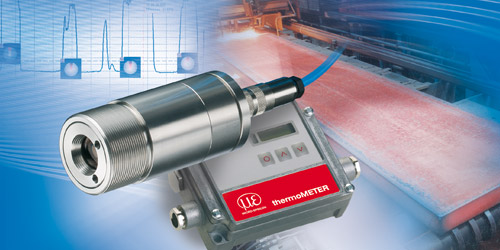
Infrared pyrometer with crosshair laser sighting and video module for metals and ceramics – thermoMETER CTVideo M1/M2
Characteristic
Measuring range (°C): 250 up to 2,200
Optical resolution: 150:1/300:1
Spectral range 1.0 and 1.6µm
Response time 1ms
Temperature value triggering with automatic snapshot
Software Compact Connect included
The infrared video thermometers CTVideo M1/M2 allow a parallel use of video sighting and crosshair laser aiming for an optimal measuring field adjustment even in processes with limited access. Due to the short wave-length of 1.0µm and 1.6µm, the sensor reliably measures temperatures of metals or ceramics and reduces possible measuring errors with surfaces with low or unknown emissivity.
Magneto-inductive displacement sensors for customer-specific requirements
Sensors can be adapted to suit customer-specific applications. Particularly for a large number of pieces, customized sensors can be produced efficiently, which results in considerable cost reductions.
The compact PCB which contains the sensor element and the evaluation electronics is responsible for the signal preparation, signal evaluation and signal output. The type of measurement (distance or rotational speed measurement) and the required frequency response are adaptable. In addition, the interfaces offer numerous connectivity options. There are several outputs such as current, voltage, PWM and further digital outputs.
The design of the housing, the material and the protection class can be adapted to the specific requirements. In cases where space is limited, the side shifted measurement offers a space-saving alternative. For harsh environments, the sensor is designed with a fully sealed stainless steel housing that withstands high pressure, dirt, aggressive chemicals (acids) and solvents.
Pre-tension for measurement against ferromagnetic objects
Magneto-inductive displacement sensors in circuit-board version
The MDS-40-LP sensors are specially designed for large volume production from 2,000 pieces or more. As these sensors are reduced to pure measurement technology, the creation of cost-effective PCB sensors was possible. Their flat design and flexible arrangement of the magnets allows easy integration in restricted spaces. Measured values are output via a rectangular signal, which is easily evaluated via, for example, digital inputs from micro-controllers.
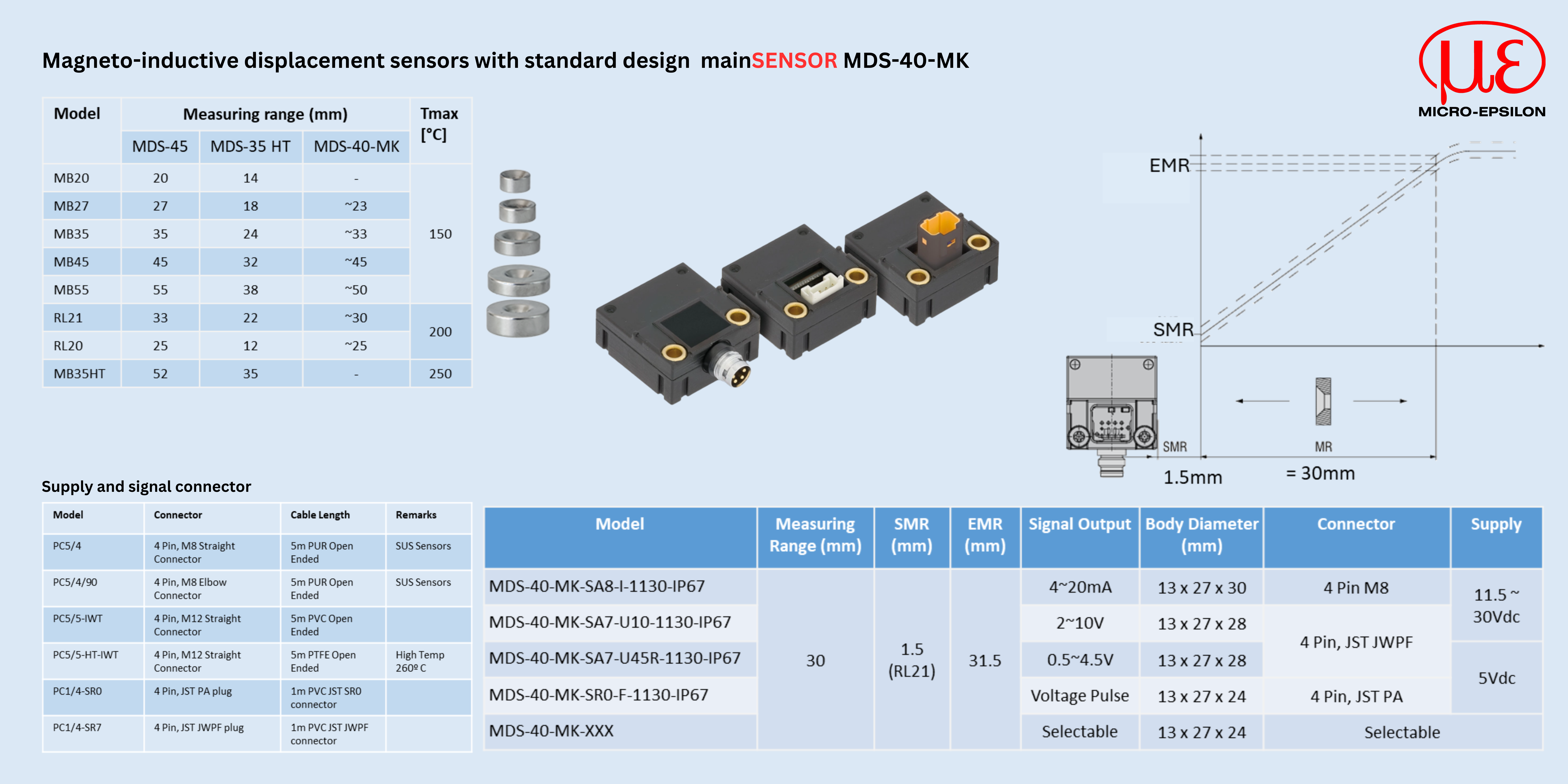
The sensors of the MDS-40-MK series are a new generation of cost-effective and flexible magneto-inductive sensors for serial or industrial applications. In addition to the pre-configured preferred types, a combination of further options (power supply, output, plug,...) is possible. The appropriate sensor can be combined from numerous configuration options.
Characteristics
Measuring range to approx. 40mm (depending from magnet used)
Output types: voltage, current, voltage (ratiometric), frequency (time measurement)
Protection class: IP20 or IP67
Configuration possibilities from 200 pc.: output / power supply / protection class / connection type
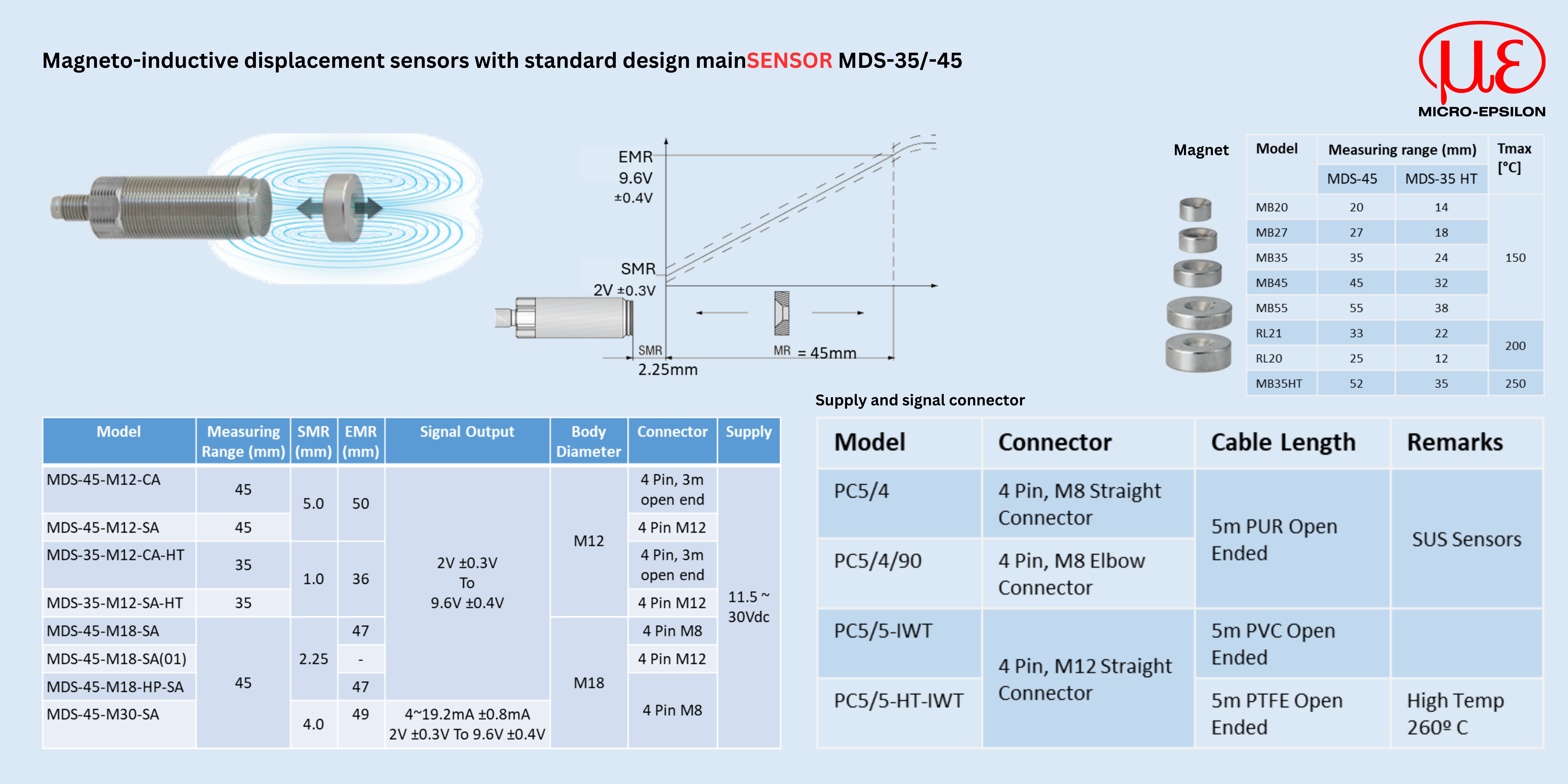
Magneto-inductive displacement sensors with standard design
The magneto-inductive MDS-35/-45 sensors are specially designed for industrial environments. The sensors are available in M12, M18 and M30 stainless steel housings or with a flat plastic housing. The pressure-resistant, stainless steel housing is ideally suited to harsh, industrial environments (dirt, oil, chemicals) and the food industry.
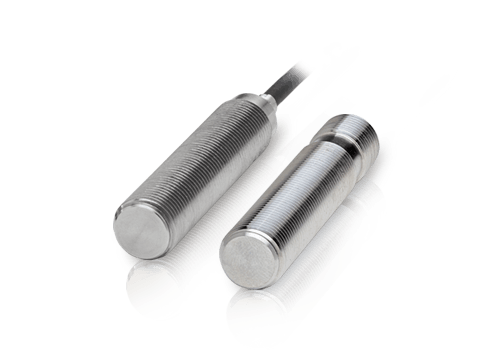
Magneto-inductive M12 sensors are industrial-grade models for restricted installation spaces. Available with either a connector or a cable, they are ideally suitable for harsh and demanding environments due to a pressure resistant housing made from stainless steel. For temperatures up to 120 °C, the high temperature MDS-35-M12-HT model is available which is also equipped with either a cable or a connector.
The MDS-45-M18 sensor is the industry-standard version of magneto-inductive sensors. The M18 design enables standardized installation and the robust stainless steel housing allows for the sensor to be installed in demanding industrial environments (dirt, oil, chemicals) or also in the food industry.
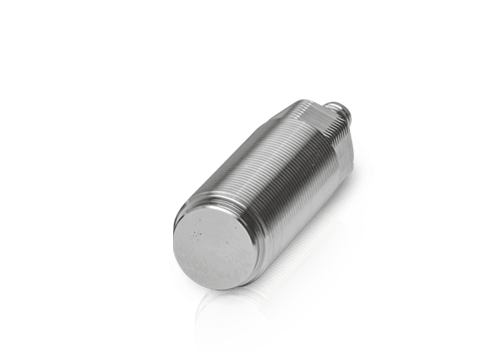
The MDS-45-M30 is the industry-standard version of magneto-inductive sensors. The M30 design enables standardized installation while the robust stainless steel housing is ideally suited to applications in harsh industrial environments (dirt, oil, chemicals) or in the food industry.



 Measuring range (°C): 250 up to 2,200